As a maritime country consisting of more than 70 percent water, Indonesia has enormous hydropower potential. The magnitude of this clean, environmentally friendly hydropower potential can simultaneously help meet Indonesia’s electricity demand. In 2021, Indonesia’s electricity consumption reached 255 TWh. This electricity consumption represents a significant increase from 174 TWh in 2012. The total energy supply is still dominated by coal at 37.6%, petroleum at 33.4%, natural gas at 16.8%, and new and renewable energy at 12.2% [1]. This breakdown means that 87.8% of Indonesia’s energy sources still come from fossil fuels. Meanwhile, through Government Regulation (PP) No. 79 of 2014, the Indonesian government targets a New and Renewable Energy (NRE) mix of 23% by 2025 and 31% by 2031. However, by the end of 2025, the NRE mix in the electricity sector had reached only 16%, indicating that the government needs to make more serious efforts to achieve this NRE target.
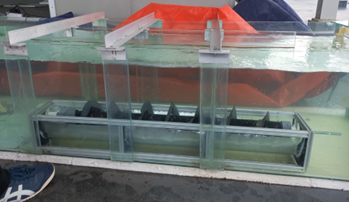
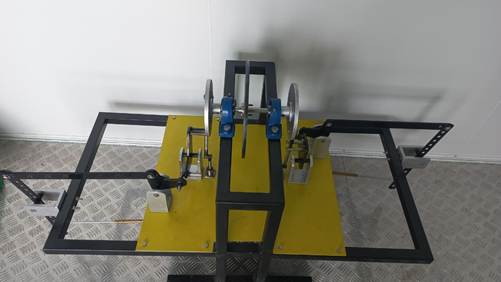
The Rainer turbine emerges as an NRE technology solution. By leveraging a tidal energy potential of 17.9 GW and the ability to operate at low speeds suited to Indonesia’s tidal currents, this turbine type features a long extraction area. This makes it highly suitable for shallow and low-velocity waters, such as Indonesian rivers and coastal areas. This turbine operates using two tandem hydrofoils capable of oscillating movements (plunging and pitching). This oscillating motion is then converted into crank rotation, which subsequently generates electrical energy.
 (a) | (b) |
Figure 1. a) Top View of the Rainer Turbine; b) Isometric View of the Rainer Turbine
Currently, research on the Rainer Turbine has been filed with the Indonesian Intellectual Property Office (IPO) and has progressed through several stages. These stages began with the turbine fabrication process in March–April 2024, followed by evaluation and design modifications to reduce the turbine’s weight, and concluded with model verification through turbine testing at Lake Puspa in June–July 2025.