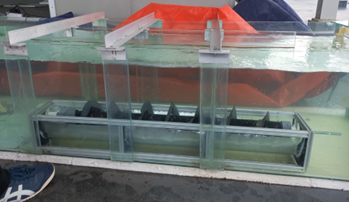
One common problem in the utilization of micro-scale hydropower is the low energy extraction efficiency in shallow river flows or in those with very low head. This is because conventional water turbines generally require a head of 5 to 10 meters to operate, with 70% of them highly dependent on high water flow. Due to the low head in these gently sloping rivers, the mechanical energy potential available for conventional turbines to generate decreases drastically, as these turbines typically achieve optimal efficiency only in high-pressure flows and are highly prone to clogging by river debris. To overcome this problem, research on the Design of an Archimedes Screw Turbine was conducted to increase energy absorption efficiency and optimize rotor rotation in low-head water flows. This screw turbine will be placed at an angle in the water channel. It will continuously rotate the generator shaft as the spaces between its helical blades are filled by water descending via gravity. The main objective of this research is to address the shortcomings of existing conventional water turbine designs, specifically their inability to operate at low water flow rates and their vulnerability to solid materials carried by the current. In this study, the turbine’s blade structure is made of stainless steel to ensure the material remains corrosion-resistant while being sturdy enough to withstand the water load. The turbine is also designed with a specific pitch and is housed within a casing with very tight clearance tolerances. This turbine design is projected to harness the available kinetic energy of a low-speed water stream. (a) (b) Figure 1. a) Top View of the Archimedes Turbine; b) Testing of the Archimedes Turbine in an Artificial Pool at the I-Cell Building, FTUI
Drone PV Panel
One common problem in the use of four-rotor unmanned aerial vehicles (UAVs), also known as drones, is the endurance of continuous operation without recharging. This is because the empty weight of a drone typically ranges from 25 kg to 100 kg, with 65% of that weight being the battery. With this massive battery weight, the maximum payload a drone can carry decreases drastically. To overcome this problem, research on the Design of a solar panel canopy for a Quadcopter UAV was conducted, focusing on increasing flight duration and reducing battery consumption for the four-rotor drone. These solar panels will be placed as a canopy above the drone’s body and will charge the battery when exposed to sunlight. The main objective of this research is to address the shortcomings of previous solar panel canopy designs on drones, which are typically attached directly to the drone’s body. In this study, the solar panel structure is made of carbon fiber to ensure it remains lightweight yet sturdy. These solar panels are also detachable and positioned above the cross-shaped rotors, consisting of 20 panels in total. These solar panels can meet 9% of the drone’s power requirements at an average solar radiation of 400–600 W/m².
Lake Toba Homestay
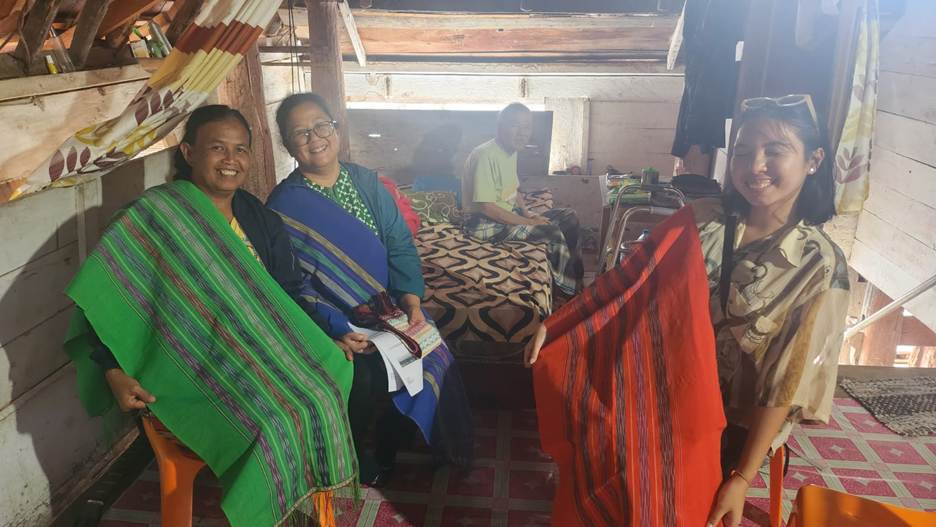
A homestay is a place of residence, typically used as accommodation for residents and tourists who wish to experience the local environment and learn about the local culture. However, ecological and socio-cultural sustainability issues pose major challenges. This is because many remote areas inhabited by indigenous Indonesian tribes tend to preserve cultural practices while facing the challenges of increasingly limited ecological conditions. Furthermore, residents are considered crucial to maintaining tourism sustainability through their proactive attitudes and support. One of Indonesia’s national destinations, Lake Toba, has been designated a priority national destination by the Indonesian Government, as specified in Government Regulation (PP) No. 50/2011 and the National Tourism Destination Master Plan for 2024-2044. To support tourism in Lake Toba, homestays are essential, as they can serve as comprehensive platforms for cultural learning. Through this research, an answer can be formulated regarding the best governance practices for homestays in Lake Toba. Figure 1. Exterior View of Rumah Bolon Used as a Homestay During the Research Visit To find this answer, the research was divided into two stages: first, identifying the sustainability values from the economic, social, and cultural perspectives of homestay owners; and second, evaluating current government regulations. These two data sets were then compared to assess the alignment between the homestay owners’ perceptions of sustainability values and prevailing government regulations. There were 12 respondents in total, comprising nine homestay owners and three government representatives. Figure 2. Data Collection Process through Interviews between the Research Team and the Local Homestay Residents The research results indicate the importance of Batak cultural values in driving homestay practices, as these are closely related to Batak philosophy, social ethics, and daily practices. In addition, government-funded renovations and the addition of public facilities have significantly improved homestay quality and visitor numbers. This is evidenced by an increase in the number of visitors, from initially only eight to hundreds after the renovations were carried out. However, the absence of a homestay association, uneven distribution of infrastructure with inconsistent quality, lack of access to cultural teaching skills, and dependence on government funding are reasons for the slow development of homestays in Lake Toba in terms of comfort, safety, and overall quality. To realize sustainable homestays, the government needs to improve the governance system through a hybrid approach involving state regulation, community leadership, and the role of intermediary organizations. Policies that encourage experience-based differentiation, cultural heritage management, and inclusive participation in the tourism value chain are more likely to reflect the community’s sustainability ideals while enhancing the destination’s long-term competitiveness.
Rainer Turbine
As a maritime country consisting of more than 70 percent water, Indonesia has enormous hydropower potential. The magnitude of this clean, environmentally friendly hydropower potential can simultaneously help meet Indonesia’s electricity demand. In 2021, Indonesia’s electricity consumption reached 255 TWh. This electricity consumption represents a significant increase from 174 TWh in 2012. The total energy supply is still dominated by coal at 37.6%, petroleum at 33.4%, natural gas at 16.8%, and new and renewable energy at 12.2% [1]. This breakdown means that 87.8% of Indonesia’s energy sources still come from fossil fuels. Meanwhile, through Government Regulation (PP) No. 79 of 2014, the Indonesian government targets a New and Renewable Energy (NRE) mix of 23% by 2025 and 31% by 2031. However, by the end of 2025, the NRE mix in the electricity sector had reached only 16%, indicating that the government needs to make more serious efforts to achieve this NRE target. The Rainer turbine emerges as an NRE technology solution. By leveraging a tidal energy potential of 17.9 GW and the ability to operate at low speeds suited to Indonesia’s tidal currents, this turbine type features a long extraction area. This makes it highly suitable for shallow and low-velocity waters, such as Indonesian rivers and coastal areas. This turbine operates using two tandem hydrofoils capable of oscillating movements (plunging and pitching). This oscillating motion is then converted into crank rotation, which subsequently generates electrical energy. (a) (b) Figure 1. a) Top View of the Rainer Turbine; b) Isometric View of the Rainer Turbine Currently, research on the Rainer Turbine has been filed with the Indonesian Intellectual Property Office (IPO) and has progressed through several stages. These stages began with the turbine fabrication process in March–April 2024, followed by evaluation and design modifications to reduce the turbine’s weight, and concluded with model verification through turbine testing at Lake Puspa in June–July 2025.