
Silakan pilih jenis layanan yang ingin Anda tanyakan:
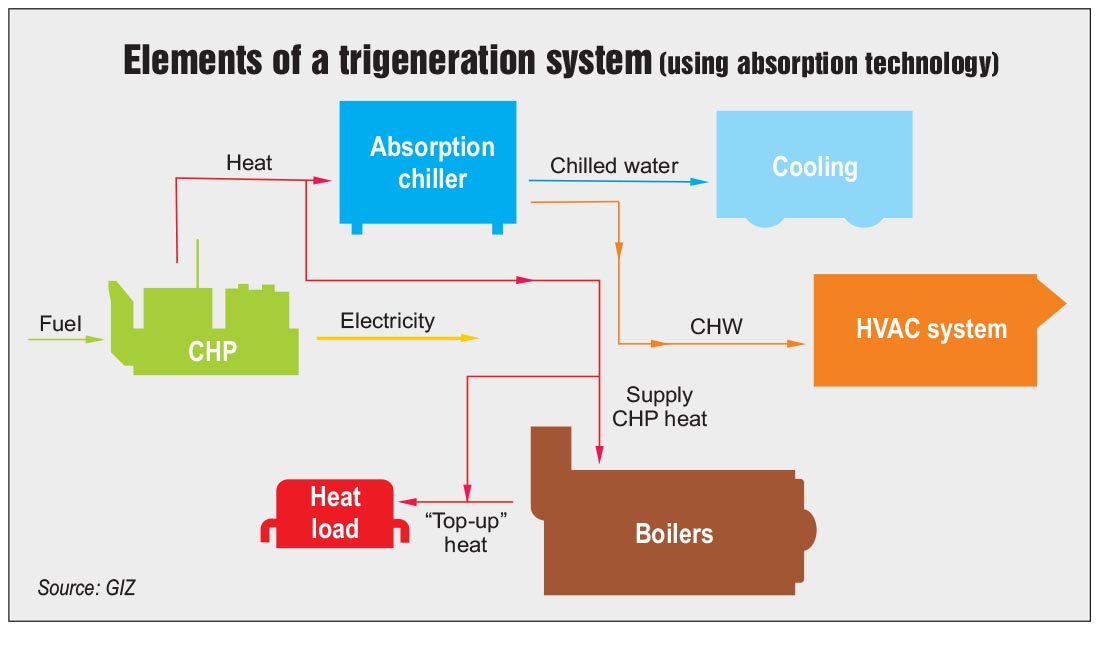
Tri-generation technology is a technology that can provide simultaneously three forms of output energy; electrical power, heating, and cooling. Trigeneration is also known as CHP (Combined Cooling, Heating and Power) or CHRP (Combined Heating, Refrigeration, and Power). In essence, trigeneration systems are CHP (Combined Heat and Power) or co-generation systems, integrated with a thermally driven refrigeration system to provide cooling as well as electrical power and heating.
CHP systems consist of a power system which can be an internal combustion engine driven by fossil fuel or a biofuel, an external combustion engine or other thermally or chemically driven systems coupled to a generator which produces electricity. A heat recovery system recovers heat from the power system and exhaust gases to be used for heating applications. The effective operation of CHP systems requires maximum utilization of both electrical power and heat. Where there are seasonal variations in heat demand, the utilization efficiency of CHP systems can be increased if the excess heat is used to power thermally driven refrigeration technologies. Trigeneration systems can have overall efficiencies as high as 90% compared to 33%-35% for electricity generated in central power plants.
On the power systems front the main developments have been on:
Progress in thermally driven cooling machines has mainly been on the development of adsorption cooling systems and multi-effect absorption systems to improve efficiency. Advances in heat transfer and heat exchanger technology now enable the manufacture of more compact heat recovery systems.
Tri-generation technology is a technology that can provide simultaneously three forms of output energy; electrical power, heating, and cooling. Trigeneration is also known as CHP (Combined Cooling, Heating and Power) or CHRP (Combined Heating, Refrigeration, and Power). In essence, trigeneration systems are CHP (Combined Heat and Power) or co-generation systems, integrated with a thermally driven refrigeration system to provide cooling as well as electrical power and heating.
CHP systems consist of a power system which can be an internal combustion engine driven by fossil fuel or a biofuel, an external combustion engine or other thermally or chemically driven systems coupled to a generator which produces electricity. A heat recovery system recovers heat from the power system and exhaust gases to be used for heating applications. The effective operation of CHP systems requires maximum utilization of both electrical power and heat. Where there are seasonal variations in heat demand, the utilization efficiency of CHP systems can be increased if the excess heat is used to power thermally driven refrigeration technologies. Trigeneration systems can have overall efficiencies as high as 90% compared to 33%-35% for electricity generated in central power plants.
On the power systems front the main developments have been on:
Progress in thermally driven cooling machines has mainly been on the development of adsorption cooling systems and multi-effect absorption systems to improve efficiency. Advances in heat transfer and heat exchanger technology now enable the manufacture of more compact heat recovery systems.